
TLDR
The best MTG starter kits are the ones that get two people playing clean games fast, not the ones that create a decorative pile of “I’ll sort this later” cardboard.
My recommendation for most casual beginners: start with the proxy route. Print two balanced beginner decks, learn by playing, then buy or upgrade once you know what you actually enjoy.
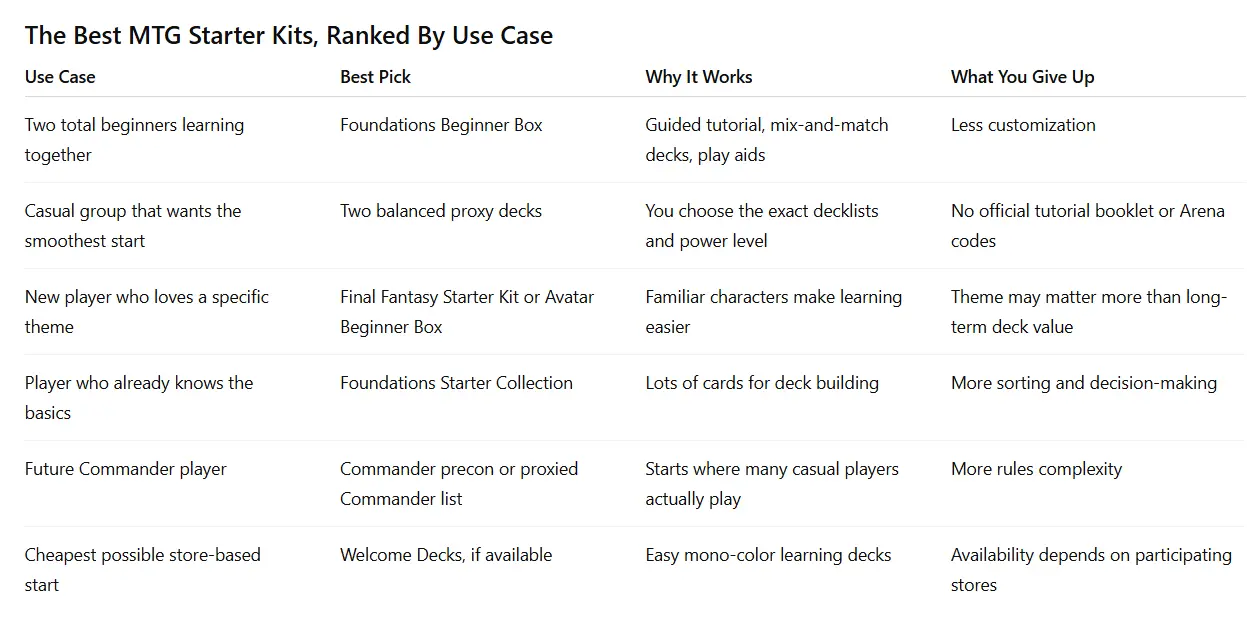
If you want an official sealed product, the Foundations Beginner Box is the best learn-to-play box, while the Foundations Starter Collection is better once you understand the rules and want to build.
If your goal is Commander, skip normal 60-card starter kits and start with a Commander precon, a proxied Commander list, or a precon plus proxy upgrades.
Magic is wonderful, but the product shelf can look like a dragon slept on a spreadsheet. The best MTG starter kits do one job: get you playing real games quickly, without making you learn deck construction, rotation, formats, card pricing, and why a land can somehow cost more than lunch.
So here is the honest answer as of May 2026: the best way to start Magic: The Gathering is usually not buying random boosters. It is either buying a focused beginner product or printing a balanced proxy starter setup. For casual kitchen table games, Commander nights, and playtesting, the proxy route is the cleanest starting point because you control the decks, the power level, and the budget from card one. Very rude of it to be that practical.
Why The Proxy Route Is The Best Starter Kit For Many MTG Beginners
The proxy route wins because it skips the most annoying beginner problem: buying something before you know what kind of Magic you like.
A sealed starter kit gives you what the box contains. That can be great. But if one player likes big green monsters and the other wants sneaky blue nonsense, a fixed box may or may not hit the table correctly. With proxies, you can build two simple decks around the experience you actually want.
For a beginner pair, I would start with two 60-card proxy decks like this:
Green-white creatures: creatures, combat tricks, simple removal, lifegain
Blue-red spells: flying creatures, card draw, burn spells, tempo plays
That gives both players different lessons. One learns board presence and combat. The other learns timing, interaction, and the great Magic tradition of saying “actually” at deeply suspicious moments.
PrintMTG is especially useful here because you can start from a list instead of hunting card by card. If you want the broader setup guide, use the MTG proxies guide and printing workflow before building your first casual starter decks.
Best Official MTG Starter Kits
1. Foundations Beginner Box
If you want an official learn-to-play product, the Foundations Beginner Box is the easiest recommendation. It is built around themed Jumpstart-style half-decks, including ordered tutorial decks that walk new players through early games.
That matters. A lot.
The biggest obstacle for new players is not “which rare is best?” It is “what am I allowed to do, when, and why is my opponent tapping all my stuff like a caffeinated accountant?” A guided beginner box helps by slowing the first game down and reducing the number of decisions.
Best for:
Two new players
Parents teaching kids
A friend group that wants training wheels for the first few games
Anyone who does not want deck construction homework yet
What you give up:
Less control over the exact decks
Not as useful once everyone knows the rules
Less exciting if your group already wants Commander
2. Foundations Starter Collection
The Foundations Starter Collection is not quite a “sit down and play instantly” product in the same way. It is better for the next step: building your first real decks.
It includes a larger card pool, basic lands, tokens, Play Boosters, and deck-building support. That makes it better for someone who already understands the basics and now wants to start making choices. Those choices will sometimes be bad. That is fine. Every Magic player deserves the humbling experience of building a 72-card deck with no removal and calling it “synergy.”
Best for:
New players who already know the turn structure
Someone who wants to build several beginner decks
Players who like sorting, tinkering, and experimenting
What you give up:
It is not as clean for a first game
It can overwhelm brand-new players
You may still need help making balanced decks
3. Final Fantasy Starter Kit
The Final Fantasy Starter Kit is one of the better themed two-player starter kits because the hook is obvious. You get two ready-to-play 60-card decks, and the cards are built around Final Fantasy characters and moments.
That theme does real work. New players remember Cloud and Sephiroth more easily than “generic efficient creature number 47.” Familiarity lowers the learning curve because the cards already feel like they belong to a world.
Best for:
Final Fantasy fans
Gift buyers
Two-player kitchen table games
People who need a theme to care enough to learn
What you give up:
Less replay variety than a Beginner Box
The theme may do more heavy lifting than the deck depth
Not the best path if your actual goal is Commander
4. Avatar Beginner Box
The Avatar Beginner Box follows the same broad logic as Foundations: themed half-decks, tutorial support, play aids, and a friendly structure for first games. If your group knows Avatar, this can be a very good teaching product.
The value is not just mechanical. Aang, Zuko, Katara, and Toph are easier to remember than a pile of unfamiliar fantasy nouns. Magic has many wonderful fantasy nouns, but sometimes it behaves like it is being paid by the syllable.
Best for:
Avatar fans
Younger learners
Two-player teaching
Groups that like theme-first learning
What you give up:
Less universal Magic identity than Foundations
Theme preference matters a lot
Availability and pricing can vary
5. Bloomburrow Starter Kit Or 2023 Starter Kit
Older two-player Starter Kits can still be good if you find them at a reasonable price. The Bloomburrow Starter Kit has two 60-card decks with clear themes. The 2023 Starter Kit also gives you two 60-card decks, with blue-red and green-white strategies.
These are solid if your goal is simple: open box, shuffle, play. They are not always the best long-term purchase, but they do exactly what a starter kit is supposed to do. That alone puts them ahead of buying random boosters and hoping a deck falls out through the power of vibes.
Best for:
Cheap two-player starts
Casual teaching
A quick gift
Players who prefer normal 60-card games over Commander
What you give up:
Less guided teaching than Foundations Beginner Box
Less customization than proxies
Older kits may be overpriced depending on supply
What About Commander Precons?
Commander is where many casual Magic players eventually land, so it is worth being blunt: if your friends play Commander, a normal 60-card starter kit may only be a short detour.
Commander precons are often a better long-term starter product because they give you a complete 100-card deck, a commander, a theme, and a real path into multiplayer games. They are more complex, but they are also closer to the games many players actually get invited to play.
My preferred route is:
Buy or choose a Commander precon style you like.
Play a few games.
Proxy 10 upgrades before buying singles.
Keep the upgrades that actually make the deck more fun.
That keeps you from turning a beginner deck into a financial sinkhole with sleeves. For a practical upgrade path, see our guide on how to upgrade a precon on a budget in MTG.
A Better Beginner Setup: Build Your Own Proxy Starter Kit
If I were setting up Magic for two new players, I would not start with boosters. I would build a small proxy starter kit:
Two balanced 60-card decks
One simple turn reference sheet
A pile of basic lands
A few extra swap cards for each deck
Sleeves for both decks
Dice or counters
A short note explaining what each deck is trying to do
That setup teaches Magic better than a random stack of cards because both decks are designed to play against each other. No one gets steamrolled by accident. No one’s first experience is mana screw followed by polite boredom. The decks can actually teach.
The best beginner proxy decks are not high-powered masterpieces. They should be boring in the right ways:
Mostly two colors
Clean mana bases
24 lands in 60-card decks
8 to 12 pieces of interaction total
Several repeat cards so beginners recognize patterns
Clear win conditions
Very few cards with novels stapled to the text box
Once the players understand the basics, then you can add spicy cards. Magic has plenty of spice. Some of it is delicious. Some of it makes everyone read Gatherer for six minutes.
My Recommendation
For most casual players, the best MTG starter kit is a proxy starter setup with two balanced decks. It is the most flexible, the most budget-friendly, and the easiest to tune around the people actually sitting at your table.
If you want a sealed official product, buy the Foundations Beginner Box first. If you already know the rules and want cards to build with, get the Foundations Starter Collection. If your group loves a specific crossover, Final Fantasy or Avatar can be a great on-ramp because enthusiasm is a real teaching tool.
But if your goal is simply “let’s learn Magic and have fun tonight,” proxies are the cleanest path. Pick two fair decks, print them well, sleeve them up, and start playing. The cardboard economy can wait its turn like everyone else.
FAQs
What Is The Best MTG Starter Kit For Complete Beginners?
The Foundations Beginner Box is the best official sealed product for complete beginners because it includes guided play materials and beginner-friendly deck combinations. For casual players who are comfortable using proxies, two balanced proxy decks are even better because you can choose the exact learning experience.
Are MTG Starter Kits Worth Buying?
Yes, if you want an easy boxed start. They are especially useful for two new players learning together. But they are not always the best long-term value if you already know you want Commander, custom decks, or a specific playstyle.
Is A Proxy Starter Kit Better Than An Official Starter Kit?
For casual learning, often yes. A proxy starter kit lets you print two balanced decks, adjust the power level, and avoid buying cards before you know what you like. Official starter kits are better if you want packaged tutorial materials, sealed product, or Arena code cards where included.
Should I Start With Commander Or 60-Card Magic?
Start with 60-card Magic if you are learning the basic rules from scratch. Start with Commander if your friends already play Commander and will help you through the first few games. A Commander precon or proxied beginner Commander list is usually better than forcing a 60-card starter kit into a Commander group.
Are Jumpstart Packs Good For Beginners?
Yes. Jumpstart is one of the better beginner formats because you combine themed packs and play quickly. The catch is that random combinations are not always equally balanced, while a curated proxy setup can be tuned more carefully.