
TLDR
The Magic: The Gathering best enchantments are the ones that keep paying you turn after turn: Rhystic Study, Smothering Tithe, Mystic Remora, Necropotence, Doubling Season, Sylvan Library, Underworld Breach, and Darksteel Mutation are all standouts.
For Commander, prioritize enchantments that draw cards, make mana, protect your board, or shut down a problem commander. For casual testing, proxies are useful because many top enchantments are expensive, and discovering that your “perfect” $50 card is clunky in your deck is a tiny tragedy with sleeves.
Why Enchantments Are So Good In MTG
The Magic: The Gathering best enchantments tend to share one trait: they sit on the battlefield and make every turn harder for your opponents or easier for you. Very polite. Very annoying. Basically the Magic equivalent of a homeowner association with card advantage.
Enchantments are strong because they usually generate ongoing value. A creature might attack once and get vaporized by a Doom Blade. An enchantment like Rhystic Study, Smothering Tithe, or Phyrexian Arena can sit there quietly making the game about itself until somebody finally spends removal on it.
That is why the best enchantments in MTG are rarely just “big effects.” They are engines. They turn normal game actions into value. Your opponents cast spells? You draw. They draw cards? You make Treasure. You create tokens? You create twice as many tokens, because apparently one army was not dramatic enough.
If you are building a casual Commander deck and want to test pricey enchantments before committing, the MTG proxies guide from PrintMTG is a useful place to start. Testing is especially helpful with enchantments because the card that looks busted on paper may do absolutely nothing in your actual pod. Magic is humbling like that.
Magic: The Gathering Best Enchantments By Role
Not every deck wants the same enchantments. A Simic tokens deck and a Rakdos graveyard deck do not need the same tools, unless your deckbuilding process is “jam expensive cards and hope the table respects the vision.”
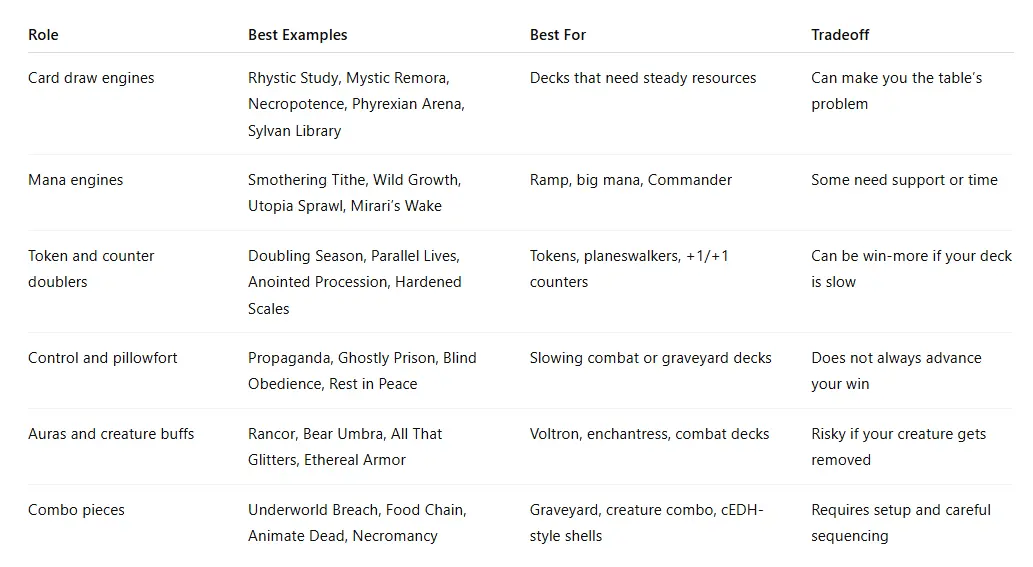
Here is the clean way to think about enchantments:
The Best Card Draw Enchantments
Rhystic Study
Rhystic Study is the most famous blue enchantment tax engine in Commander for a reason. It turns every opponent’s spell into the same social experiment: “Are you going to pay the 1?” Most people will not. They have dreams, and those dreams involve using their mana.
The card is excellent because it scales in multiplayer. In a four-player Commander game, you are not waiting for your one opponent to cast spells. You have three opponents feeding the machine. Sometimes they pay. Often they do not. Either way, Rhystic Study changes how the table plays.
Best in: blue Commander decks, control decks, value decks, decks that can protect early engines.
What you give up: table goodwill. Not all of it, but enough that you may want to look humble while drawing your seventh extra card.
Mystic Remora
Mystic Remora is cheaper than Rhystic Study and often more explosive. It taxes noncreature spells with a very unpleasant payment requirement, which makes it especially good in faster tables where players rely on mana rocks, tutors, and interaction.
The drawback is cumulative upkeep. Mystic Remora asks you to keep paying more mana each turn, like a subscription service that knows you forgot to cancel. In many games, that is fine. You only need one or two turns of value for the card to be absurd.
Best in: faster Commander, spell-heavy pods, decks that can capitalize on early card draw.
What you give up: long-term stability. Remora is usually a burst engine, not a forever engine.
Necropotence
Necropotence is one of the scariest black enchantments ever printed. It lets you trade life for cards at a rate that makes normal card draw look like it got lost in the parking lot.
The catch is that Necropotence changes how your turn works. You skip your draw step, and the cards you pay life for arrive later. In the right deck, that is not a drawback. It is a scheduling issue. In the wrong deck, it can feel awkward, especially if you do not have the life total, mana, or timing to use the new cards properly.
Best in: black decks with life gain, combo decks, decks that can use life as a resource.
What you give up: simplicity. Necropotence is powerful, but it asks you to know what you are doing. Rude, but fair.
Sylvan Library
Sylvan Library is green card selection with optional card advantage. It lets you see more cards every turn and pay life when you really need to keep extras.
It is less flashy than Necropotence and less socially irritating than Rhystic Study, which is why it often survives longer than it should. The card is especially strong in decks that shuffle often, gain life, or need to find specific pieces.
Best in: green midrange, combo, lands, and toolbox decks.
What you give up: raw draw volume unless you are willing to spend life.
The Best Mana Enchantments
Smothering Tithe
Smothering Tithe is one of white’s best Commander cards because it solves white’s historical problem of “I would like mana, please.” Whenever opponents draw cards, they either pay 2 or you get Treasure. They usually do not pay 2. They are busy pretending they might.
Smothering Tithe gets silly with wheel effects, group draw, and long multiplayer games. Even without combos, it can quietly produce enough mana to turn your medium board into a terrifying board.
Best in: white Commander decks, big mana decks, artifact/Treasure decks, decks with draw-wheel effects.
What you give up: four mana upfront. It is not cheap, but the ceiling is enormous.
Wild Growth And Utopia Sprawl
These are not as glamorous as Smothering Tithe, but they are excellent. Wild Growth and Utopia Sprawl enchant lands and make extra mana early. In enchantress decks, they also trigger your enchantment-draw effects while ramping you.
This is where newer players sometimes miss the point. The best enchantments are not always the big splashy ones. Sometimes the best enchantment is the one that lets you cast your commander a turn early and then draw a card from your enchantress payoff. Efficient cards are boring until they win.
Best in: enchantress decks, green ramp decks, low-curve Commander builds.
What you give up: late-game impact. These are best early.
Mirari’s Wake
Mirari’s Wake doubles your mana from lands and buffs your team. That makes it excellent in Selesnya creature decks, token decks, and any green-white deck that wants to stop asking politely and start casting haymakers.
Best in: Selesnya tokens, creature-heavy Commander, big mana decks.
What you give up: five mana. You need enough lands and follow-up plays for it to matter.
The Best Token And Counter Enchantments
Doubling Season
Doubling Season is the poster child for “this might get out of hand.” It doubles tokens and counters, which makes it absurd with token makers, +1/+1 counter strategies, and planeswalkers.
The card is not automatically correct in every green deck. If your deck only makes a few tokens or barely uses counters, Doubling Season is expensive decoration. Very fancy decoration, but still.
Best in: tokens, counters, planeswalkers, Atraxa-style decks, Simic and Selesnya value piles.
What you give up: speed. At five mana, it needs your deck to follow through.
Parallel Lives And Anointed Procession
Parallel Lives and Anointed Procession are cleaner token doublers. They do not double counters, but they cost less or fit colors Doubling Season does not. If your deck only cares about tokens, these are often exactly what you want.
Best in: token decks, populate decks, sacrifice decks that need fodder.
What you give up: flexibility. They do one job. Thankfully, the job is “make twice as much stuff,” so nobody is crying.
Hardened Scales
Hardened Scales is one mana and can snowball quickly in +1/+1 counter decks. It is not as dramatic as Doubling Season, but the efficiency is the point. Getting extra counters every time you place counters adds up fast.
Best in: counter decks, modular decks, creature growth strategies.
What you give up: broad usefulness. It needs a deck built around counters.
The Best Removal And Control Enchantments
Darksteel Mutation
Darksteel Mutation is one of the best Commander answers because it can turn a scary commander into an indestructible 0/1 Insect with no abilities. That is beautiful in the way a parking ticket is beautiful when it happens to somebody else.
It does not technically remove the creature from the battlefield, which can be a feature. Many commanders would rather be destroyed so they can return to the command zone. Darksteel Mutation leaves them sitting there, deeply employed as a bug.
Best in: white Commander decks that need commander answers.
What you give up: the permanent still exists. Some decks can sacrifice or bounce it.
Song Of The Dryads And Imprisoned In The Moon
These are excellent because they answer nearly anything. Song of the Dryads turns a permanent into a Forest. Imprisoned in the Moon turns a creature, land, or planeswalker into a colorless land with limited function.
They are especially good against commanders and problem permanents that your colors otherwise struggle to remove.
Best in: green or blue Commander decks needing flexible answers.
What you give up: opponents may still benefit from the land, and enchantment removal can undo your hard work.
Propaganda And Ghostly Prison
These pillowfort enchantments tax attacks against you. They do not stop every threat, but they make random chip damage much less appealing.
Best in: control, pillowfort, slower Commander decks, planeswalker decks.
What you give up: they do not stop combo kills or noncombat damage. A tax booth is not a bunker.
Rest In Peace
Rest in Peace shuts down graveyards hard. It is excellent if your table is full of reanimator, escape, flashback, dredge, or aristocrats nonsense. Yes, graveyard decks have several flavors of nonsense. It is a rich buffet.
Best in: white decks that do not need their own graveyard.
What you give up: your graveyard too. Do not run this in your own reanimator deck unless you enjoy sabotaging yourself for sport.
The Best Aura Enchantments
Rancor
Rancor is still one of the cleanest creature Auras ever printed. It gives power, trample, and returns to your hand when it goes to the graveyard from the battlefield. That last clause is what makes it special. Auras often get you two-for-oned. Rancor shrugs and comes back.
Best in: aggressive green decks, Voltron, creature combat decks.
What you give up: not much. It is cheap, efficient, and annoying. A fine resume.
Bear Umbra
Bear Umbra gives a creature +2/+2, totem armor, and untaps your lands when that creature attacks. That can produce huge mana swings, especially with commanders that attack safely.
Best in: Voltron, green Commander decks, combat-trigger decks.
What you give up: four mana and reliance on attacking.
All That Glitters And Ethereal Armor
These are premium aggressive Auras for decks with lots of enchantments and artifacts. In the right shell, they turn a tiny creature into a credible threat fast.
Best in: enchantress aggro, Voltron, artifact/enchantment-heavy decks.
What you give up: vulnerability. If the creature gets removed at the wrong time, you may have donated your whole turn to the graveyard.
The Best Combo Enchantments
Underworld Breach
Underworld Breach is one of red’s most explosive enchantments. It gives cards in your graveyard escape, which can turn your graveyard into a second hand for one turn. In tuned decks, one turn is plenty. Sometimes too plenty.
It is strongest when paired with cheap spells, self-mill, rituals, wheels, or cards that generate mana while filling the graveyard.
Best in: combo decks, spell-heavy red decks, graveyard decks.
What you give up: graveyard dependency. If someone has Rest in Peace, Underworld Breach mostly becomes a sad little rectangle.
Animate Dead And Necromancy
These classic reanimation enchantments bring creatures back from the graveyard and attach to them. They are efficient, flexible, and strong in decks that want to cheat big creatures into play.
Best in: reanimator, sacrifice decks, graveyard Commander decks.
What you give up: vulnerability to enchantment removal and graveyard hate.
Food Chain
Food Chain is a combo engine that exiles creatures to make mana for creature spells. It is not a generic value card. You play Food Chain when your deck is built to break Food Chain.
Best in: dedicated creature combo decks.
What you give up: deckbuilding freedom. Food Chain asks for commitment, not a casual situationship.
Good, Better, Best: How To Choose Enchantments For Your Deck
Here is the simple framework.
Good enchantments help your deck do its normal thing. Phyrexian Arena draws cards. Wild Growth ramps. Ghostly Prison buys time.
Better enchantments multiply your deck’s core plan. Enchantress’s Presence in an enchantment deck is better than generic draw. Hardened Scales in a counter deck is better than a random value engine.
Best enchantments change the game while fitting your plan. Rhystic Study draws because opponents play Magic. Smothering Tithe ramps because opponents draw cards. Doubling Season doubles the exact resources your deck already makes.
Use this rule:
If an enchantment is strong only when you are already winning, be suspicious.
If an enchantment helps when you are behind, even, or ahead, it is probably worth testing.
That is why the Magic: The Gathering best enchantments are not just famous cards. They are cards that create pressure, value, or inevitability across many game states.
A Practical Testing Checklist
Before you buy or proxy an expensive enchantment, ask:
Does this card work without my commander?
Does it help the turn I cast it, or does it need another full turn cycle?
Does my deck naturally support it?
Does it draw removal away from my win condition, or is it my win condition?
Is it still good if I am behind?
Am I playing it because it fits, or because the internet yelled the card name at me?
That last one catches more deckbuilding mistakes than people want to admit.
If you are testing a full Commander list with several high-value enchantments, it may be cleaner to print a test deck first. PrintMTG’s guide on how to make proxy MTG cards that look clean and shuffle smoothly is useful if you want the deck to feel playable during actual games, not like a pile of printer paper having a personal crisis.
My Shortlist: The Best MTG Enchantments Overall
If I had to make one practical shortlist, here it is:
Rhystic Study: Best blue draw-tax engine.
Smothering Tithe: Best white mana engine in Commander.
Mystic Remora: Best early burst draw enchantment.
Necropotence: Best black life-for-cards engine.
Doubling Season: Best token/counter multiplier.
Sylvan Library: Best green card selection engine.
Underworld Breach: Best red combo enchantment.
Darksteel Mutation: Best white commander-neutralizing Aura.
Rest in Peace: Best clean graveyard shutdown enchantment.
Rancor: Best low-cost aggressive Aura.
That is not a universal “jam all ten” list. It is a toolbox. Pick the ones that match your deck’s plan, power level, and tolerance for becoming the person everyone attacks “for no reason.”
FAQs
What Is The Best Enchantment In Magic: The Gathering?
For Commander, Rhystic Study is often the strongest overall enchantment because it turns opponents’ normal spellcasting into card advantage for you. Smothering Tithe, Mystic Remora, Necropotence, and Doubling Season are also serious contenders depending on the deck.
What Is The Best White Enchantment In MTG?
Smothering Tithe is usually the best white enchantment for Commander because it creates Treasure whenever opponents draw cards and do not pay the tax. Darksteel Mutation is one of the best white Aura answers for problem commanders.
What Is The Best Green Enchantment In MTG?
Doubling Season is the biggest green enchantment payoff for tokens, counters, and planeswalkers. Sylvan Library is better if your deck wants consistent card selection instead of a huge board-scaling effect.
Are Auras Worth Playing In Commander?
Auras are worth playing when your deck protects the enchanted creature, recurs Auras, or gets paid for casting enchantments. Rancor, Bear Umbra, All That Glitters, and Ethereal Armor are strong examples. Random Auras in random decks are risky, because removal can turn them into a two-card loss.
Should I Proxy Expensive Enchantments Before Buying Them?
For casual deck testing, yes. Many of the best enchantments in Magic: The Gathering are expensive, and proxies let you test whether the card actually fits your deck before spending real money. Your wallet deserves at least one blocker.