

TLDR
A lot of classic MTG Modern staples didn’t get “strictly replaced.” Modern got faster, threats got stickier, and answers got cheaper.
Prices crashed because demand crashed (fewer top decks want these cards) and supply rose (reprints, bonus sheets, “The List,” etc.).
Most of these cards are still perfectly playable in the right context (Commander, Cube, pet decks). They’re just not automatic 4-ofs anymore.
If you want to relive old-era Modern without paying nostalgia tax, proxies are a sane way to test, as long as you keep it casual and clear.
This post helps Modern and kitchen-table players understand why once-dominant MTG Modern staples fell in power and price, so you can decide whether to buy, trade, keep, or proxy them.
Remember when your deck was also your rent payment
There was a time when saying “Tarmogoyf, Snapcaster Mage, Liliana of the Veil” felt like reading off the ingredients list for a Modern top 8. These cards weren’t just good. They were the default settings. They were also, inconveniently, expensive.
The most iconic “this game is a financial hostage situation” moment might still be Pascal Maynard taking a foil Tarmogoyf in a Grand Prix top 8 draft over Burst Lightning, because the rare was worth so much money it basically counted as a prize payout. That whole mini-scandal only makes sense in a world where the card was functionally a coupon for hundreds of dollars. In 2026, it reads like a period piece.
So what happened? Did these cards suddenly become bad?
Not exactly. The format changed around them.

The big idea: staples don’t die, the format texture changes
Power creep is real, but it’s rarely “they printed Tarmogoyf but better.” Most of the time it’s this:
The threats that matter now either replace themselves, do something immediately, or end the game quickly.
The interaction got cheaper and more flexible.
A lot of decks learned they can’t spend early turns on cards that only pay you back “eventually.”
Old staples that were designed to win fair games over several turns are still strong in fair games over several turns. Modern just stopped promising you those games.
A quick framework: 5 ways a Modern staple gets benched
If you want a simple mental model for why yesterday’s all-star becomes today’s binder decoration, it’s usually one (or more) of these:
No immediate value
If the card doesn’t do anything right away, it’s gambling that it lives. Modern loves punishing that.The format got faster, not just stronger
A card can still be powerful and still be too slow. Both can be true.Role compression happened
Newer cards often do two jobs at once (threat + value, removal + pressure, etc.). Older cards that only do one job get squeezed out.Cheap interaction improved
When removal is efficient and plentiful, “dies to removal” stops being a meme and becomes a business model.Reprints fixed supply, and demand left anyway
When the metagame stops wanting a card, price memory only delays the drop. It doesn’t prevent it.
Keep that list in your pocket. We’re about to use it like a flashlight in a haunted trade binder.
The “fallen three” that defined an era
These are the headline acts. The cards that used to feel mandatory.
Tarmogoyf: stats are not a retirement plan
Tarmogoyf’s whole pitch is rate. Two mana, huge body, end of story.
Modern’s response in 2026 is: “Cool. Does it do anything else?”
A two-mana beater with no enter-the-battlefield value, no card draw, no protection, and no inevitability is living in the past. It’s not that a 4/5 is bad. It’s that Modern’s baseline threats either generate value immediately or demand very specific answers. Tarmogoyf mostly just asks, “Do you have removal?” and Modern usually does.
Snapcaster Mage: the flashback tax got too expensive
Snapcaster Mage is still a great Magic card. The problem is Modern is a great Modern format.
Paying two extra mana to reuse an instant or sorcery used to be a fair deal when games were slower and your two-drop body mattered. Today, spending a whole turn’s worth of mana to “rebuy a spell” is often too clunky, and the body is not the kind of speed bump it once was. The format punishes small creatures and slow setup.
Snapcaster didn’t get worse. The opportunity cost did.
Liliana of the Veil: efficiency and board presence moved the goalposts
Liliana is still a clean design. She’s also built for a world where:
players don’t vomit multiple bodies onto the board early, and
discard reliably strips the key card before it matters.
Modern got better at both deploying threats and refilling. A three-mana planeswalker that asks you to trade resources over time is fine, but it’s no longer the fear engine it used to be.
Five more fallen giants (and what pushed them out)
The original “poster kids” are only part of the story. Here are five more cards that used to define tables, then got politely escorted to the side.
1) Dark Confidant: the classic card advantage engine that now feels like self-harm
Dark Confidant used to be the premier “answer this or lose” two-drop. If it lived, you buried people in cardboard.
Modern and even Standard environments since then have gotten faster and more punishing. Confidant is the purest form of delayed value: it has to survive, and then it makes you pay life for your trouble. That deal is a lot worse when:
removal is plentiful,
one-toughness creatures get punished,
and decks routinely play higher-impact, higher-cost cards.
The funniest part is that “Bob” showing up again in a Standard-legal product didn’t recreate the old dominance. The game around it changed.
2) Karn Liberated: the Tron payoff that stopped being the best seven mana thing
Karn Liberated was the nightmare scenario for years. “Assemble Tron, exile your best permanent” was the whole script.
Two things happened:
Modern got better at pressuring and disrupting big mana.
Tron got more options. The format’s top-end threats diversified, and the best payoff isn’t always the original terror-plane.
Karn is still powerful. It’s just no longer synonymous with “this is what Tron does.” That alone is enough to gut demand.
3) Wrenn and Six: still good, but no longer the center of the universe
Wrenn and Six is a great example of a card that can remain strong while its dominance fades.
At peak, it was everywhere because it did two quietly broken things:
guaranteed land drops (especially with fetchlands), and
cleaned up small creatures efficiently.
But the metagame shifted, answers changed, and the decks that once built around Wrenn evolved. It’s still playable. It’s just not the automatic cornerstone it once was, and the price reflects that.
4) Ragavan, Nimble Pilferer: the monkey learned what a metagame is
Ragavan is still a one-mana threat that can run away with games. That part didn’t change.
What changed is the environment:
more efficient interaction,
more bodies that block profitably,
and more cards that punish small creatures trying to connect.
Ragavan’s story is also a good reminder that “not dominating anymore” is not the same as “unplayable.” Demand can cool while the card remains strong.
5) Jace, the Mind Sculptor: four mana at sorcery speed is a big ask now
For a long time, Jace was the ceiling. The face. The “this is what a broken planeswalker looks like” card.
Then the game printed a lot of planeswalkers and threats that compete for that same slot, while also making “tap out for four mana” a more dangerous life choice in multiple formats. Jace’s best mode is tied to drawing extra cards, and the ecosystem around that got harsher.
Jace isn’t trash. He’s just no longer the default best thing you can do for four mana.
The price collapse, in one table
Prices move for two reasons: how many copies exist, and how badly people want them. The second part is where “fallen staples” really hurt.
Here’s the short version: many of these cards hit absurd highs, then fell to “honestly I’ve paid more for sleeves” territory.
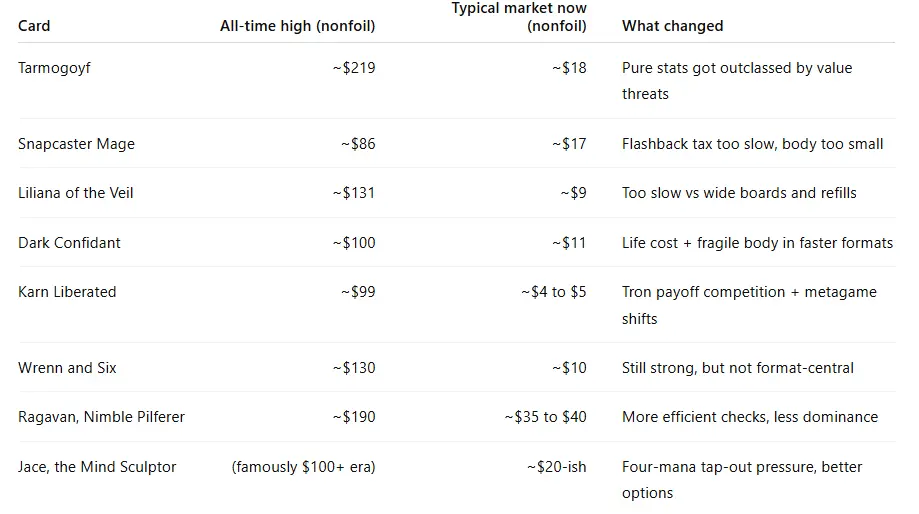
Don’t treat these numbers like a stock chart you can day-trade. They’re just a snapshot of how brutally demand can evaporate once a card stops being a default choice.
So do these cards “suck” now?
No. They’re just honest now.
They used to be priced and played like inevitabilities. Now they’re priced and played like tools. If your deck wants the tool, great. If it doesn’t, the card doesn’t get to bully its way into the list on reputation alone.
That’s not a tragedy. It’s healthy. It also means you can build “classic” decks, cubes, and throwback nights without selling plasma.
What you should do if you own (or want) these fallen staples
Here’s a practical decision tree that doesn’t require a finance YouTube degree.
Keep them if:
you play Commander or Cube and like the card’s play patterns
you enjoy nostalgia decks (Jund players, I see you, I respect the commitment)
you want the option to pivot if the metagame shifts again (it happens)
Trade or sell them if:
they’re just sitting there and you’d rather convert into lands, staples you actually play, or store credit
you have premium versions you’re not emotionally attached to
Proxy them if:
you want to test a deck before buying into it
you want multiple decks without moving the same card back and forth like it’s a shared custody arrangement
you want to keep originals safe while still playing the deck regularly
A quick sanity check: proxies are for casual play and playtesting. If you’re playing sanctioned events, you should assume you need authentic cards, with narrow judge-issued exceptions for damaged cards during the event.
Proxies, tournaments, and the part where we are boring on purpose
PrintMTG exists because people want:
consistent, readable playtest cards,
decks that shuffle normally,
and a way to experiment without turning Modern into a subscription service.
But we also keep the line very clear:
Not for sanctioned tournaments
Not for resale as real cards
Not for anything that tries to confuse anyone
If you want the “house rules” version of this, it’s basically: tell your pod, keep it readable, and don’t be sketchy. The game is fun. Don’t make it weird.
If you’re printing or ordering proxies and you care about the physical feel, sizing matters. A lot. Even tiny scaling mistakes turn into “why does this one card feel off?” real fast.
FAQs
Why did these MTG Modern staples drop so hard in price?
Because demand dropped. Modern stopped wanting them as defaults, and reprints increased supply. The price followed the metagame.
Are any of these still playable in Modern?
Some see occasional play, and local metas vary a lot. But “playable” is different from “automatic 4-of staple,” which is what drove the old prices.
Did reprints matter more than power creep?
They worked together. Reprints increase supply, but supply only crushes price when demand is no longer holding it up.
Can I use proxies at FNM or in a tournament?
If the event is sanctioned, assume no. The only proxies typically allowed in sanctioned play are judge-issued proxies in narrow situations (like a card becoming damaged during the event).
When does it make sense to proxy a card that’s cheap now?
When you want to test decks fast, keep originals safe, or build multiple lists without juggling the same cards. Cheap does not always mean “convenient.”