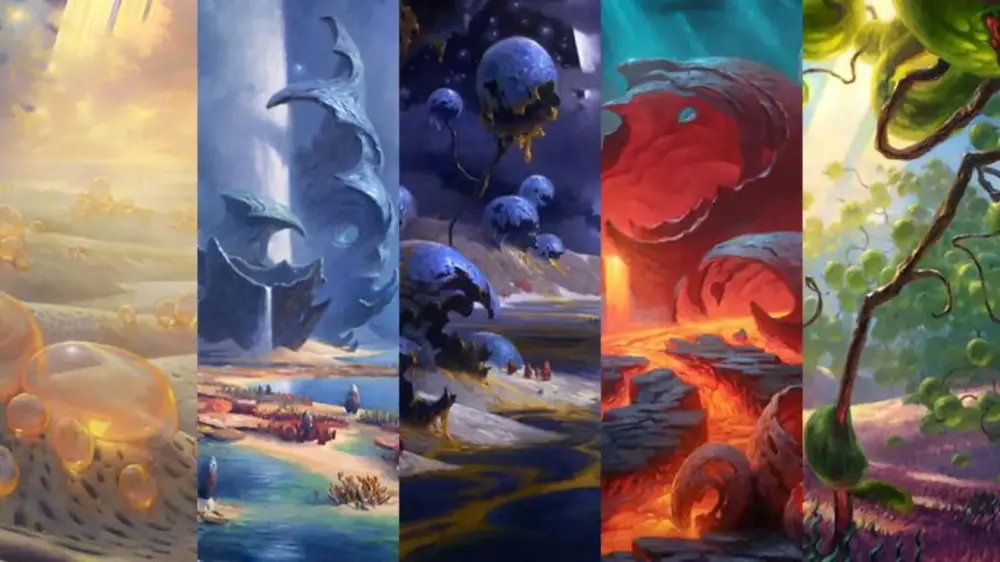

In late 2021, the Unfinity Planetary Basic Lands quietly reminded everyone that basic lands are not “just basics.” On December 2, 2021, a full cycle of five original paintings by Adam Paquette, one each for Plains, Island, Swamp, Mountain, and Forest, sold for $56,000 on the MTG Art Market. For a lot of players, that number is either jaw-dropping or completely unsurprising. Sometimes it’s both.
What made this sale hit is how universal basic lands are. Every deck uses them. Every draft uses them. And full-art basics are one of the few things in Magic that are both functional game pieces and tiny collectible posters you shuffle.
These specific lands were the “Planetary” cycle made for Unfinity: space environments that still read like Magic’s five colors, even when you strip away the usual castles, swamps, and mountains we’ve been trained to expect.
What actually sold, and why the Unfinity Planetary Basic Lands mattered
Paquette’s five pieces were traditional paintings (oil on paper), mounted on Aluminum-Dibond, each at 35 cm x 50 cm. That size is big enough to feel like “real art on a wall,” not “nice art for a card game,” even if the card game is the reason it exists.
And the set mattered as a set. Collectors love cycles. A matching five-color run is the kind of thing you rarely get to buy in one clean shot, especially with lands. So when a full cycle shows up, people who collect Magic art tend to treat it like a “don’t blink” moment.
There’s also the simple truth: full-art lands age well. A flashy mythic can fall out of favor. A land is a land forever. If you’re the kind of person who wants one purchase to stay relevant across formats, lands are a safe bet.
Adam Paquette’s sci-fi influences and the five-color “feel”
One of the coolest parts of this cycle is that it’s clearly “space,” but it still reads as Magic. That is harder than it sounds.
Paquette talked about pulling from classic sci-fi and fantasy influences, including Moebius and Roger Dean, plus a childhood deep cut that shaped how he thinks about alien environments. But the more interesting bit, in my opinion, is the design problem he solved: how do you paint five different planets that still feel like Plains, Island, Swamp, Mountain, and Forest?
His answer was to treat the colors as environments, not just lore boxes. So instead of asking, “What does the story say this world is?” the question becomes, “What does White feel like as a place?” That mindset is why the cycle works even if you’ve never read a single Un-set story blurb in your life.
And yeah, collectors noticed. The buyer who landed the set basically said the quiet part out loud: a complete land cycle is a grail, and Un-set full-art lands hit a special nerve.
The Unfinity release date changed, but the art hype didn’t
Here’s the funny thing about the original writeups from 2021: they mention Unfinity as if it’s about to drop on April 1, 2022. That was the plan. Then reality happened.
Wizards announced the set would be delayed, eventually landing on October 7, 2022 instead. The reason given at the time was supply chain complications. So the cards arrived later, but the art sale didn’t wait. The originals were already doing their job: making people want the lands before the set even existed in binders.
That’s kind of the point of land art, honestly. Lands are the mood lighting of Magic. They set the vibe of your deck even when they’re not the “cool” cards.
How to enjoy the land art without needing $56,000
Most of us are never buying original Magic paintings, and that’s fine. You can still build a deck that looks how you want it to look.
One route is to pick a land cycle you love and commit to it. Play more basics. Tune the vibe. It sounds silly until you shuffle up a deck where every land matches and the whole thing feels intentional.
Another option is playtesting and casual builds with printed stand-ins, especially if you want a specific look for a deck theme. If you’re new to that side of the hobby, our guide on how to make MTG proxies explains the basics without making it weird. And if you’re the DIY type who cares about crisp text and clean cuts, Mastering Printing MTG Cards: A Step-by-Step Guide goes deeper on files, sizing, and finishing.
None of that replaces owning original art, obviously. But it does get you most of the day-to-day joy. You still get to sit down, draw your opening hand, and see a little “planetary” moment staring back at you before you even cast a spell.
And maybe that’s the takeaway from the Unfinity Planetary Basic Lands sale: the best Magic art does two jobs at once. It can live on a wall. And it can live on the table, over and over, until the corners of your sleeves start to haze.
As Unfinity from Magic: The Gathering prepares for its release on April 1, 2022, stay tuned to PrintMTG for more extraordinary artwork and updates on this otherworldly set.