
TLDR
The best places to learn about misprinted Magic cards online are MisprintedMTG, MTG Wiki, Draftsim, Cardsphere, MTG Misprint Glossary, Magic Librarities, Reddit, and dedicated Facebook groups.
Start with general guides first, then move to collector groups if you need help identifying or selling a specific card.
Not every printing flaw is valuable. Severity, scarcity, card demand, and buyer interest matter a lot.
Filler cards and “DISCARD” cards are a separate but related oddity worth researching if you pulled a blank, barcode, test-pattern, or discard-marked card.
If you own a valuable misprint, keep it protected and use a PrintMTG proxy for casual play instead of shuffling the real card.
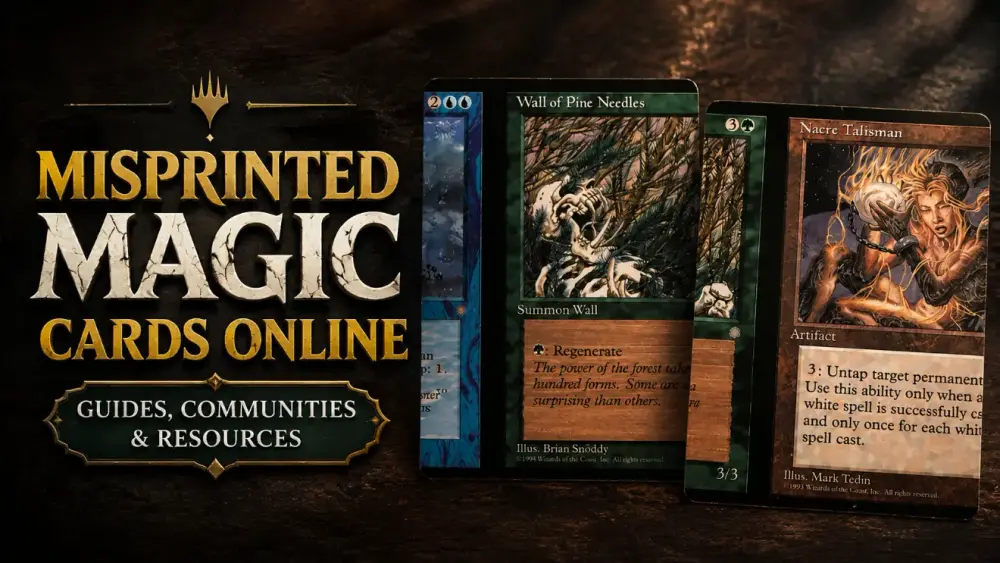
Misprinted Magic cards online are one of those rabbit holes that looks small from the outside and then suddenly eats your whole evening. One minute you’re checking whether your card is slightly off-center. The next you’re reading about crimps, ink errors, shifted foils, filler cards, and a Commander deck that somehow came out looking like the printer had a very bad day.
That’s part of the fun. Magic: The Gathering has been printed for decades across different sets, products, languages, frames, foiling methods, and factories. With that much cardboard in circulation, errors happen. Some are minor. Some are famous. Some are barely worth mentioning. And a few become prized collector pieces.
So where can you find reliable information about misprinted Magic cards online? Start with the sources below.
The Best Places To Research Misprinted Magic Cards Online
There is no single official price guide for MTG misprints. That’s the first thing to understand.
Normal cards have cleaner market data because thousands of copies may sell through marketplaces and stores. Misprints are different. A single error can be rare, hard to compare, and only interesting to a narrow group of collectors. That means you need a mix of reference sites, collector guides, community posts, and sold listings.
The best approach is simple:
Learn the type of error.
Compare it to known examples.
Check whether the error is severe enough to matter.
Ask experienced collectors before selling.
Avoid trusting one random comment as a final appraisal.
That last one matters. Everyone has an opinion on the internet. Not everyone has bought or sold real MTG misprints.
MTG Wiki: Good For Definitions And Known Examples
MTG Wiki is a useful first stop because it explains what a misprint is and gives examples from Magic’s history. It’s especially helpful when you are trying to separate broad categories, like an editorial mistake versus a mechanical printing error.
Use MTG Wiki when you want to answer basic questions like:
What counts as a misprint?
Has this card or set had a known error before?
Is this a documented issue or just damage?
Was the card printed incorrectly across many copies?
MTG Wiki is not usually the best place to determine value. It is better as a background source. Think of it as the “what am I looking at?” step before you move into collector-specific research.
MisprintedMTG: The Best Beginner Resource For Serious Misprint Learning
MisprintedMTG is one of the strongest resources for learning the hobby. Its beginner guide explains major categories like miscuts, crimps, ink errors, foil shifts, and other printing oddities. It also does a good job explaining severity.
Severity is the part new collectors often miss.
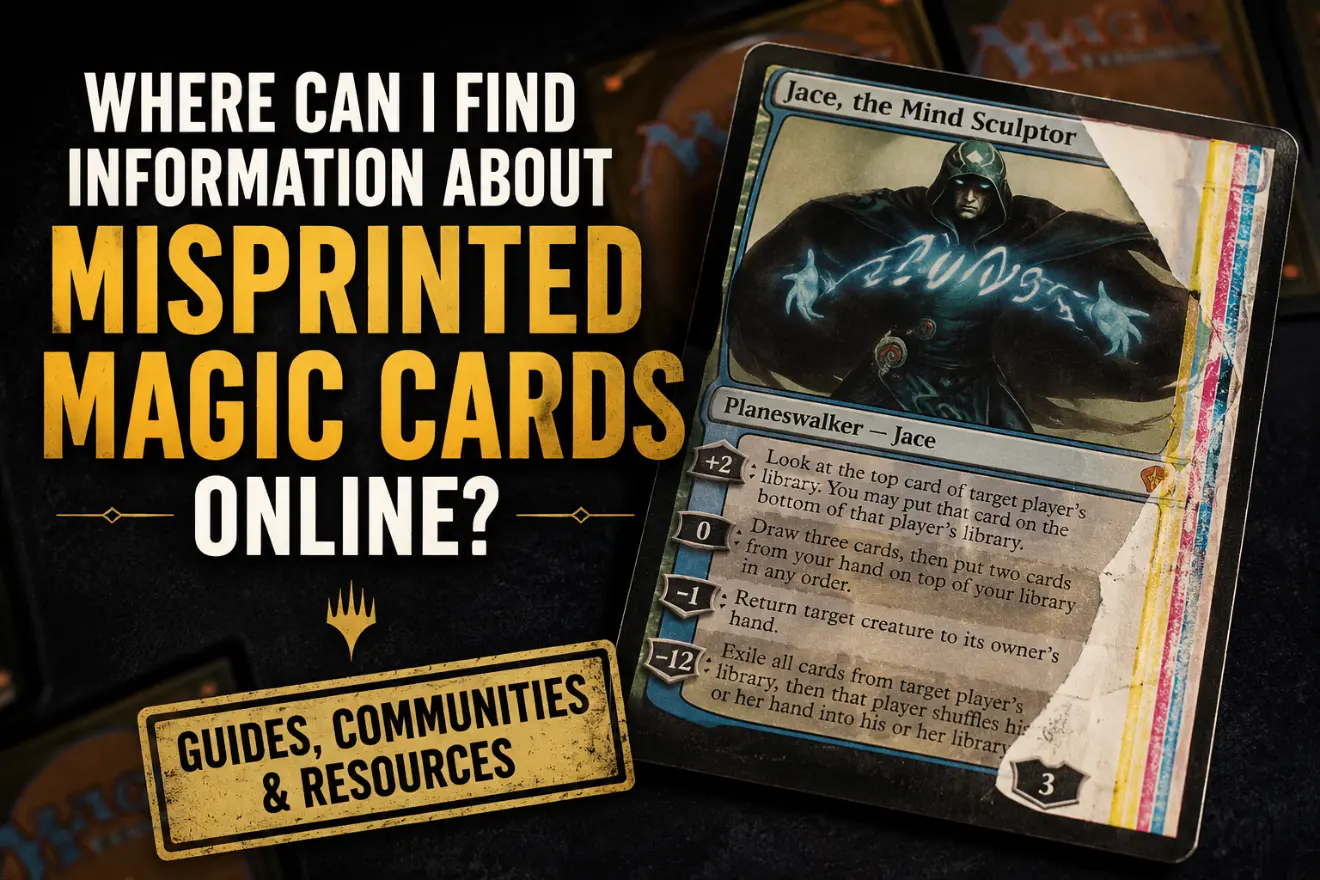
A tiny dot, light color variation, or slightly rough edge may technically be a production flaw, but that does not mean collectors will care. A dramatic miscut, a visible crimp, a shifted foil layer, or an obvious wrong-back error is much easier to understand and usually more interesting to buyers.
MisprintedMTG is also helpful because it talks about pricing in a more realistic way than “it’s worth whatever someone pays.” That phrase is technically true, but it does not help anyone. Better pricing research looks at similar errors, sold listings, severity, scarcity, demand, and the card’s normal collectibility.
Use MisprintedMTG when you want to learn:
Misprint terminology
What makes an error severe
How to photograph and describe an error
How to think about supply and demand
How misprint collectors tend to evaluate cards
If you only read one dedicated misprint site, start there.
Draftsim: Easy-To-Read Examples And Collector Context
Draftsim is a good source when you want misprints explained in a more article-style format. Its misprint content breaks down common categories and shows why some errors are interesting beyond just “this card looks wrong.”
That makes it useful for casual players who are new to misprint collecting. Draftsim is also good at explaining value and legality in plain language, which helps if you are coming from normal Commander or Limited play and not from the collector side.
Use Draftsim when you want:
A readable overview
Examples of memorable misprints
Context for why collectors care
Basic legality and value discussion
It is a nice middle point between wiki-style reference and deep collector documentation.
Cardsphere And Beckett: Collector-Focused Articles
Cardsphere’s blog has published useful writing on factory errors in Magic. It is worth checking when you want a collector-oriented explanation of how different errors show up and why some matter more than others.
Beckett is also useful because it comes from a broader collectibles angle. Its misprint coverage helps separate true factory errors from normal variation, intentional alternate versions, or corrected text issues.
That distinction matters. A card can be unusual without being a high-value misprint. Some things are normal print variation. Some are known set-wide mistakes. Some are damaged after leaving the factory. Some are counterfeit concerns. Good collector writing helps you sort those apart before you get too excited.
And yes, getting excited is understandable. Pulling a strange card from a pack feels like finding a secret door.
MTG Misprint Glossary: Useful, But Read The Caution Notes
The Magic Misprint Glossary is useful when you are trying to find the right words for an error. Misprint terminology can get messy, and this kind of glossary helps with categories like layout errors, stock errors, stamping errors, cutting errors, cornering errors, machine impression errors, and packaging errors.
Use it as a terminology tool, not a final appraisal tool.
The site itself notes that information is still being gathered and fact checked, so it should not be treated as the final word on every case. That is fine. Glossaries are still helpful because they teach you how collectors talk about different types of errors.
And when you know the right words, your searches get much better.
Instead of searching “my Magic card is messed up,” you can search:
“MTG crimp error”
“MTG shifted foil”
“MTG miscut showing another card”
“MTG registration error”
“MTG filler card”
“MTG discard filler”
That saves a lot of time.
Magic Librarities: Best For Oddities, Fillers, And Historical Curiosities
Magic Librarities is one of the better places to browse old Magic oddities, promos, test items, filler cards, and unusual print objects. It can feel a bit old-school as a website, but that is part of the charm. More importantly, it has information and examples that are hard to find elsewhere.
This is especially helpful for filler cards and “DISCARD” cards.
Filler cards are not normal playable Magic cards. They are placeholder cards connected to the printing and sheet process. Sometimes they appear as blank fronts, barcode cards, solid color cards, “X” cards, or cards marked with “DISCARD.” These are supposed to be removed before products reach players, but some make it into the wild.
That is why collectors care. A filler card is not exciting because it wins games. It is exciting because it was not supposed to end up in your booster pack at all.
What Are “DISCARD” Cards And Filler Cards?
“DISCARD” cards are one of the more famous MTG oddities. They usually show the word “DISCARD” or some other factory-facing marker on a card-like object. The basic idea is simple: the card is not meant to be part of the finished product.
Filler cards can show up in several forms:
Blank white or blank black fronts
Barcode or tracking-style marks
Border-only filler fronts
“X” or test-pattern designs
“DISCARD” text
Partial borders
Solid filler designs
Strange back/front combinations
These cards are not normal game pieces. They do not have a legal Magic card name, mana cost, type line, or rules text. They are collectible oddities.
If you pull one, do not throw it away. Sleeve it, photograph it, and research it. You may not have a jackpot, but you do have something more interesting than a random draft common.
Reddit: Good For First Reactions, Not Final Value
Reddit can be useful, but you need to use it carefully.
General Magic communities like r/magicTCG or r/mtg can help you get quick eyes on a card, but those spaces are not always built for detailed misprint appraisal. You may get helpful comments. You may also get jokes, guesses, or conflicting answers.
More focused subreddits and threads can be better for identifying whether something looks like a real factory error, a normal quality-control issue, post-pack damage, or a possible counterfeit concern.
When posting, include:
A clear front photo
A clear back photo
Photos of the edges and corners
The set name and language
Whether you opened it from sealed product
Any matching errors on nearby cards from the same pack
A normal copy beside it, if possible
Bad photos lead to bad answers. That is not Reddit’s fault. Mostly.
Facebook Groups: Often The Best Place For Serious Appraisal
For serious misprint collecting, Facebook groups still matter. A lot of experienced MTG misprint buyers, sellers, and collectors use dedicated groups for identification, auctions, and discussion.
The big advantage is that many active buyers are already there. That means you can get a better sense of whether your card has real demand. The downside is that group rules can be strict, and low-severity posts may not always be welcome.
Before posting, read the rules. Then read them again.
Most groups want clean photos, accurate descriptions, and no misleading claims. Some groups separate major errors from minor errors. Some allow sales. Some are mostly for identification. Follow the group format, and you will usually get better help.
How To Tell If Your Misprint Might Be Valuable
Misprint value is not just about rarity. It usually comes down to several factors working together.
A card is more likely to be interesting if the error is obvious at a glance. A dramatic miscut, a crimp through the card, a shifted layer, or a wrong-back error is easier to sell than a tiny ink dot.
The normal card also matters. A misprinted Sol Ring, Rhystic Study, basic land with popular art, Commander staple, Reserved List card, or iconic card may attract more attention than a misprinted bulk common. Collectors often care about the card itself, not just the error.
The likely value depends on:
Error severity
How scarce the error appears to be
Whether the card is playable or collectible
Whether similar examples have sold
Condition
Language and set
Current demand from niche collectors
Whether the error is easy to prove as factory-made
One important warning: asking prices are not the same as sold prices. Anyone can list a misprint for a huge number. That does not mean it is worth that number. Sold listings, real auction results, and collector group feedback are more useful.
What To Do If You Find A Misprinted Magic Card
If you think you found a real MTG misprint, slow down and protect the card first.
Do this:
Sleeve the card immediately.
Avoid bending, cleaning, flattening, or “fixing” anything.
Take clear photos in natural light.
Photograph the front, back, edges, and corners.
Keep the packaging if the card came from a fresh pack.
Compare it to a normal copy.
Search the exact card name plus the likely error type.
Ask a dedicated misprint group before selling.
Do not rush to sell to the first person who sends a direct message. That might be a fair buyer. It might also be someone hoping you do not know what you have.
If the card looks valuable, give yourself time to learn.
Why PrintMTG Matters If You Own A Valuable Misprint
Here is the practical problem with valuable misprints: you probably should not shuffle them.
Even if a misprinted card is technically playable in your casual group, repeated shuffling, sleeving, unsleeving, and table handling can damage it. If the card has collector value, the smart move is to protect the original and use a proxy for normal gameplay.
That is where PrintMTG fits naturally.
PrintMTG lets you print MTG proxy cards for casual play, Commander nights, Cube, and playtesting. You can print a clean version of the card for your deck while keeping the real misprint safe in a sleeve, binder, or top loader. You can also use the MTG Card Maker to create custom cards and tokens for casual projects, as long as your group is clear that they are not official tournament-legal Magic cards.
That distinction matters. PrintMTG is for playable proxies and custom casual pieces. It is not a way to pass anything off as a real misprint, counterfeit, or tournament card.
Use the real misprint as a collectible. Use the proxy as the game piece. Everyone wins, and your expensive oddity does not slowly become “heavily played” because you wanted to cast it in a Wednesday night Commander pod.
You can start here:
PrintMTG homepage: https://printmtg.com/
PrintMTG Card Maker: https://printmtg.com/mtg-card-maker/
PrintMTG FAQ: https://printmtg.com/frequently-asked-questions/
How to Make MTG Proxies: https://printmtg.com/how-to-make-mtg-proxies/
Are Misprinted Cards Legal To Play?
Sometimes, but it depends.
A normal Magic card with a minor factory error may be acceptable in many settings if it is recognizable, not marked, and not creating confusion. In formal events, the judge is the final authority. Proxies are different. Wizards has stated that sanctioned events require authentic Magic cards, except for judge-issued proxies in specific damage situations during an event.
For casual play, talk to your group.
If you are using a proxy because the real card is valuable or fragile, say that upfront. Most Commander groups are fine with a readable proxy when everyone understands what the card is. Problems happen when players hide information, use unclear cards, or bring a power level the table did not agree to.
A good script is:
“I own the real misprint, but I don’t want to shuffle it. This is a proxy of the normal card for casual play. Is that okay?”
That is usually enough.
Common Mistakes To Avoid When Researching MTG Misprints
The biggest mistake is assuming every flaw is valuable. Magic cards are mass-produced. Small centering issues, minor color shifts, and tiny print dots happen. Some are collectible. Many are not.
Another mistake is confusing damage with factory errors. A dent, scratch, stain, crease, or water mark after the card left the pack is usually just damage. It can still be interesting to you, but collectors usually treat factory errors very differently from post-production wear.
Also avoid using normal card pricing sites as your only source. TCGplayer, Card Kingdom, and similar marketplaces are useful for normal cards, but rare misprints often need collector-group context and sold-listing research.
And finally, do not overclean or alter the card. The oddity is the point. Trying to make it look better can make it less collectible.
The Best Search Terms To Use
Use specific search terms. Broad searches get messy fast.
Try:
“MTG misprint guide”
“Magic The Gathering misprint examples”
“MTG miscut card”
“MTG crimp error”
“MTG shifted foil”
“MTG registration error”
“MTG filler card”
“MTG discard filler”
“MTG barcode filler”
“MTG blank front misprint”
“Magic misprint glossary”
“MTG misprint Facebook group”
“MTG misprint sold listings”
If you know the exact card, add the card name. If you know the set, add the set name. If the card is non-English, add the language. The more precise you are, the more useful the results get.
Final Thoughts
The best information about misprinted Magic cards online comes from a mix of reference sites, collector guides, community groups, and market research. MTG Wiki and Draftsim are good starting points. MisprintedMTG is the strongest place to learn the hobby in depth. Magic Misprint Glossary helps with terminology. Magic Librarities is useful for oddities and filler cards. Reddit and Facebook groups are where you can get real eyes on a specific card.
Just be careful with value claims. Misprints are not priced like normal cards. The market is smaller, more personal, and more dependent on collector interest.
If you find something interesting, protect it first. Learn what it is. Ask the right people. And if it turns out to be worth keeping safe, use PrintMTG to make a clean casual proxy for gameplay while the real card stays protected.
That is the cleanest way to enjoy the card without turning every shuffle into a tiny financial mistake.
FAQs
What Is A Misprinted Magic Card?
A misprinted Magic card is a card that was manufactured incorrectly. That can include mechanical printing errors, cutting errors, ink problems, foil shifts, crimps, wrong backs, missing elements, or other factory-made mistakes.
Are MTG Misprints Worth Money?
Some are, but many are not. Value depends on severity, scarcity, card demand, condition, and buyer interest. Major, obvious, rare errors on desirable cards are usually more interesting than tiny flaws on bulk cards.
Where Should I Ask About A Misprint I Found?
Start with MisprintedMTG and MTG Misprint Glossary to learn the terminology. Then post clear photos in a dedicated MTG misprint Facebook group or relevant Reddit community if you need help identifying or valuing the card.
What Is A “DISCARD” MTG Card?
A “DISCARD” card is a type of filler or factory oddity that was not meant to be included in finished products. Some have the word “DISCARD,” while others may be blank, black, barcode-marked, or printed with test-style elements.
Should I Play With A Valuable Misprint?
Usually no. If the card has real collector value, protect it. Use a clearly understood proxy for casual games and keep the original safe.
Can PrintMTG Make A Proxy Of A Card I Own As A Misprint?
PrintMTG can help you print a clean casual proxy or custom card for playtesting, Commander, Cube, and kitchen-table play. Do not use proxies as counterfeits, and do not represent custom cards as official tournament-legal Magic cards.
References
PrintMTG: https://printmtg.com/
PrintMTG Card Maker: https://printmtg.com/mtg-card-maker/
PrintMTG FAQ: https://printmtg.com/frequently-asked-questions/
PrintMTG, How to Make MTG Proxies: https://printmtg.com/how-to-make-mtg-proxies/
Wizards of the Coast, On Proxies, Policy, and Communication: https://magic.wizards.com/en/news/announcements/proxies-policy-and-communication-2016-01-14
MTG Wiki, Misprint: https://mtg.fandom.com/wiki/Misprint
MisprintedMTG, Beginner’s Guide to Misprints: https://www.misprintedmtg.com/beginners-guide-to-misprints
MisprintedMTG, Pricing Misprints: https://www.misprintedmtg.com/pricing
MisprintedMTG, Filler ID List: https://www.misprintedmtg.com/filler-id
Draftsim, The 25 Weirdest and Coolest Misprints in Magic: https://draftsim.com/mtg-misprints/
Cardsphere, Misprints and Human Mistakes: https://blog.cardsphere.com/misprints-and-human-mistakes-a-brief-guide-to-factory-errors-in-magic-the-gathering/
MTG Misprint Glossary: https://www.mtgmisprintglossary.com/
Magic Librarities, Filler Cards: https://www.magiclibrarities.net/1205-rarities-filler-cards-english-cards-misprinted-fillers.html