
TLDR
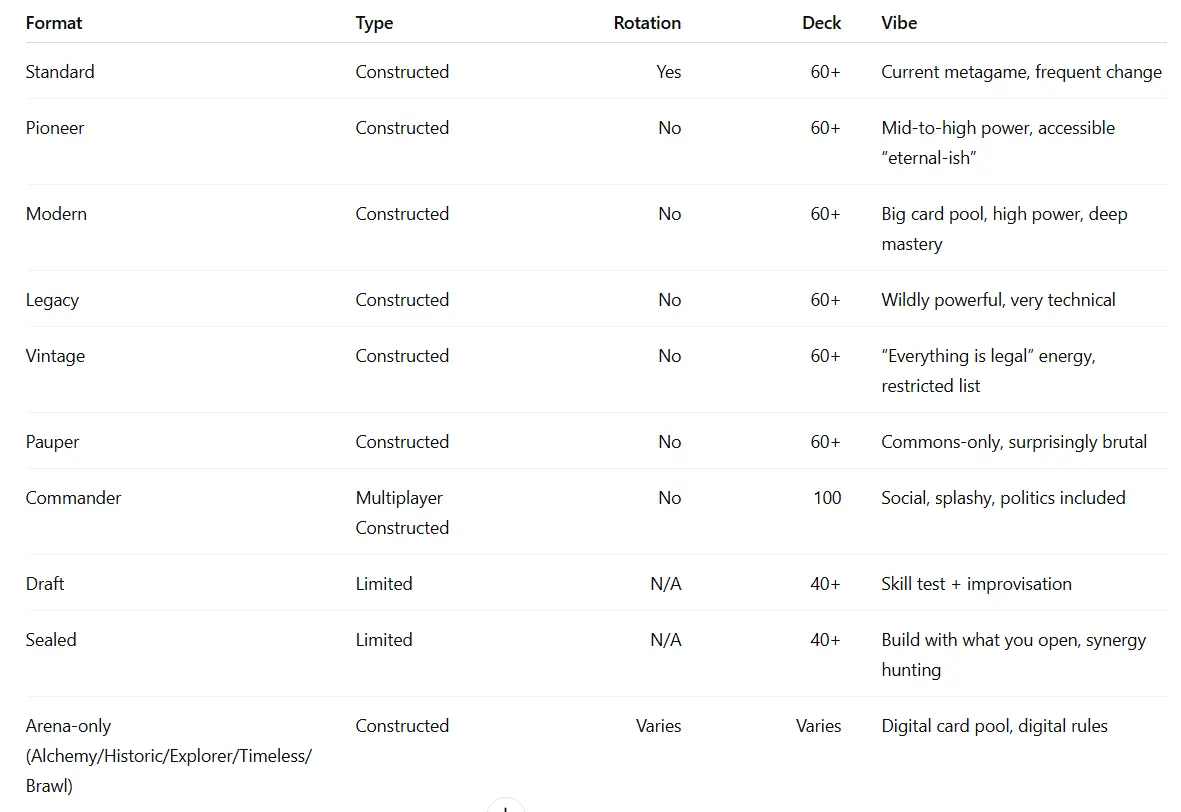
Standard is the rotating “current sets” format. Rotation now runs on a three-year cycle, so your deck gets to live a little longer before it becomes a historical artifact.
Pioneer (Return to Ravnica forward) and Modern (Eighth Edition forward) are the big non-rotating paper formats with lots of competitive play.
Legacy and Vintage are the deep end of the pool. Vintage also has a restricted list (one copy) instead of only bans.
Commander is the social, 100-card singleton format (usually 4 players, 40 life). It’s where deckbuilding is an art form and threat assessment is a performance.
Draft and Sealed are Limited formats where you build from packs on the spot.
Digital adds its own menu: Alchemy, Historic, Explorer, Timeless, and Brawl on MTG Arena.
Why “MTG formats” exist (besides making you own more cards)
Formats are Magic’s way of answering one simple question: “Are we playing the game where your friend casts Black Lotus, or the game where we pretend we’re normal?”
An MTG format is basically a rules wrapper: what sets are legal, how you build your deck, and sometimes how the games are played. Pick the format first, then build the deck. Doing it the other way around is how you end up with a beautiful pile of cardboard that legally belongs to absolutely nowhere.
Constructed formats (you bring a deck)
Constructed is what most people mean when they say “I built a deck.” You pick a format, follow its legality rules, and show up with your 60-card masterpiece (or your 100-card Commander novel).
Standard
Standard is the flagship rotating format. It uses the most recent sets, and it rotates once per year (after the fall set prerelease) with the oldest sets leaving the format. In 2023, Standard’s rotation was extended to a three-year cycle, which means your cards and decks generally stick around longer than they used to. That’s nice. You can grow attached before the inevitable happens.
Who Standard is for
Players who enjoy a changing metagame and regular deck evolution
Anyone trying to play “current Magic” in a competitive environment
People who don’t mind updating lists often (or who secretly enjoy it)
What it costs
Not always cheap, but usually cheaper than older formats
The real cost is emotional: your favorite deck will rotate, eventually
Pioneer
Pioneer is non-rotating and includes sets from Return to Ravnica forward. It’s designed as a middle ground: more powerful than Standard, less historically vast than Modern or Legacy. If you want a format where your deck remains legal but you’re not trying to source ancient cardboard from a vault, Pioneer is the pitch.
Who Pioneer is for
Players who want non-rotation without Modern’s full chaos
Anyone who likes “real” competitive play with a manageable card pool
Modern
Modern is non-rotating and starts at Eighth Edition forward. It’s one of the most popular long-term paper competitive formats because it rewards mastery. You can keep tuning the same deck for years, which is either comforting or deeply enabling. Possibly both.
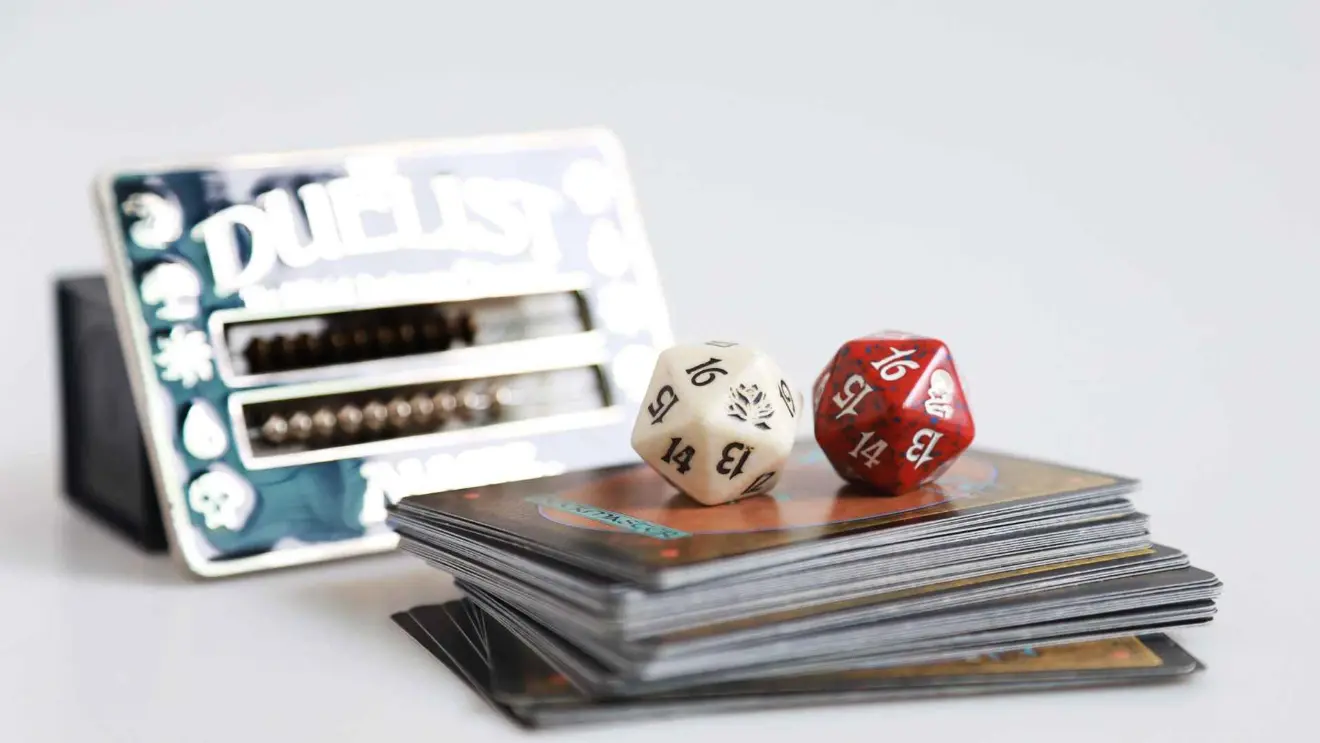
Modern’s card pool is massive, the strategies are diverse, and the power level is high. Games can be fast, but the decisions are rarely simple.
Who Modern is for
Competitive grinders and format specialists
Players who want long-term deck ownership
Anyone who likes learning matchups like they’re studying for an exam
Legacy
Legacy is where Magic’s entire history shows up, minus a banned list. The format is famous for depth, efficiency, and games where a single mis-sequenced land drop feels like a signed confession.
Legacy is also expensive in paper because many key cards are scarce. That’s not “gatekeeping” so much as “economics, unfortunately.”
Who Legacy is for
Players who love technical play and powerful interactions
Folks who enjoy high agency and big brains
Anyone with access to a Legacy community (it’s regional)
Vintage
Vintage is the closest Magic gets to “anything goes,” with two important caveats:
It has a small banned list
It uses a restricted list, meaning certain cards are limited to one copy per deck
This is the home of iconic power and absurd starts. It’s also the home of a dedicated community that has collectively accepted that this is what they enjoy, and that is beautiful.
Who Vintage is for
People who want maximum power
Players who enjoy wild stack battles and broken mana
MTGO players especially, since paper Vintage is rare and expensive
Pauper
Pauper is commons-only. Which sounds like it should be gentle, right up until you realize a lot of commons are basically crimes that happen to be printed in black ink.
Pauper is loved because it’s comparatively budget-friendly while still being competitive and deep. Deckbuilding is constrained in a way that rewards creativity and tight play.
Who Pauper is for
Budget-conscious competitive players
Anyone who likes efficient decks and real interaction
Players who want a “serious format” without premium price tags
Multiplayer formats (where the table talks back)
Commander (EDH)
Commander is a 100-card singleton format built around a legendary “commander” and a color identity rule. Games are typically multiplayer free-for-all, and players start at 40 life.
Commander is the most popular way people play paper Magic, mostly because it’s social and expressive. Also because you can play cards you love even if they’d be terrible in a strict 1v1 format. Commander is generous like that.
Two Commander realities can both be true
It’s casual and social.
It can also be extremely tuned and competitive (cEDH), depending on the pod.
Recent official materials also highlight optional “Commander Brackets” and a “Game Changers” concept intended to help players communicate deck power expectations. If your group already does a pregame conversation, this is basically that, but with a label.
Who Commander is for
Players who like big plays, variety, and social games
People who enjoy deckbuilding as self-expression
Anyone who wants to use a wide card pool without chasing a rotating metagame
Brawl
Brawl is basically “Commander, but Arena-sized.” Historically, Brawl has been a 60-card singleton commander format using a Standard-like card pool. On MTG Arena, there’s also Historic Brawl, which expands legality to a larger card pool.
One wrinkle: Wizards’ current Brawl format page lists 100-card Brawl with 25 life and 1v1 play on Arena, while other official explainer content describes Brawl as 60-card. If you see confusion online, that’s why. In practice, when someone says “Brawl,” ask one clarifying question: “60-card or 100-card?”
Who Brawl is for
Arena players who want Commander flavor in shorter games
Newer players learning singleton deckbuilding without 100 cards of homework
Limited formats (you build from packs)
Limited is the fastest way to get better at card evaluation, curve building, and damage math. It is also the fastest way to realize you kept a hand you absolutely should not have kept.
Draft (Booster Draft)
In Draft, players open packs, pick one card at a time, and build a 40-card minimum deck from what they drafted. The skill is not just “pick good cards,” it’s picking good cards that work together, while reading signals and staying flexible.
Draft is perfect if you like:
On-the-fly deckbuilding
Learning a set deeply
Winning with cards you would never sleeve in Constructed
Sealed
In Sealed, you open (usually) six boosters and build a 40-card minimum deck from that pool. It’s less about reading a draft table and more about squeezing the best plan out of what you opened.
Sealed shows up a lot at prereleases because it’s a clean test of fundamentals and adaptation.
Digital formats (MTG Arena has its own ecosystem)
If you mainly play on MTG Arena, you’ll hear these names constantly. They’re all “MTG formats,” but they’re tuned for digital reality.
Explorer
Explorer is Arena’s “tabletop-authentic” non-rotating lane intended to mirror Pioneer as closely as possible with the card pool available on Arena. Wizards has explicitly positioned Explorer as the on-ramp to full Pioneer support over time.
Alchemy
Alchemy is a Standard-based digital format that includes digital-only cards and rebalanced versions of existing cards. It rotates, and it changes more aggressively than paper formats because it can. Some people love that. Some people would rather eat sleeves. Both are valid.
Historic
Historic is Arena’s big non-rotating digital-first format. It allows digital-only cards and rebalanced cards, and it’s curated over time.
Timeless
Timeless is Arena’s “power format.” It’s non-rotating, uses a restricted list, and aims to let players use the strongest things available on the platform while still preventing the format from turning into “who drew the same two cards first” forever.
Choosing the right MTG format (a practical framework)
If you’re stuck, decide in this order:
Where are you playing?
Paper at an LGS: Standard, Pioneer, Modern, Commander, Draft, Sealed.
Arena: Standard, Explorer, Historic, Timeless, Alchemy, Brawl.Do you want rotation?
Yes: Standard (and Alchemy).
No: Pioneer, Modern, Legacy, Vintage, Pauper, Commander (and most Arena non-rotating formats).Do you want social multiplayer or competitive 1v1?
Social: Commander first, then maybe Brawl on Arena.
Competitive: Standard, Pioneer, Modern, Legacy, Pauper.How much complexity do you enjoy?
Lower to moderate: Standard, Pioneer, Sealed.
High: Modern, Legacy, Vintage, Draft, Commander (yes, Commander can be complex).
Where proxies fit (quick clarity, no weirdness)
If you’re using proxies for casual play, Commander nights, Cube, or playtesting, you’re in familiar territory. Most groups are fine with it if you communicate clearly and your cards are readable and consistently sleeved.
For sanctioned events, you generally need authentic cards, with very limited judge-issued proxy exceptions for damaged cards during the event. Store policies also vary, so ask before you show up with anything unusual. This is not legal advice, it’s social survival advice.
FAQs
What’s the best MTG format for beginners?
If you want structured learning: Standard (especially on Arena) or Sealed at prerelease events. If you want social play with friends: Commander, ideally with a precon and a patient table.
What’s the difference between Pioneer and Modern?
Both are non-rotating 60-card formats. Pioneer starts at Return to Ravnica. Modern starts at Eighth Edition. Modern has a bigger card pool and usually a higher power ceiling.
Does Standard still rotate every two years?
No. Standard rotation was extended to a three-year cycle starting with changes announced in 2023.
What’s the difference between Historic and Timeless on Arena?
Historic is digital-first and includes rebalanced and digital-only cards. Timeless is meant to be the “everything” Arena format and uses a restricted list to manage the most powerful cards.